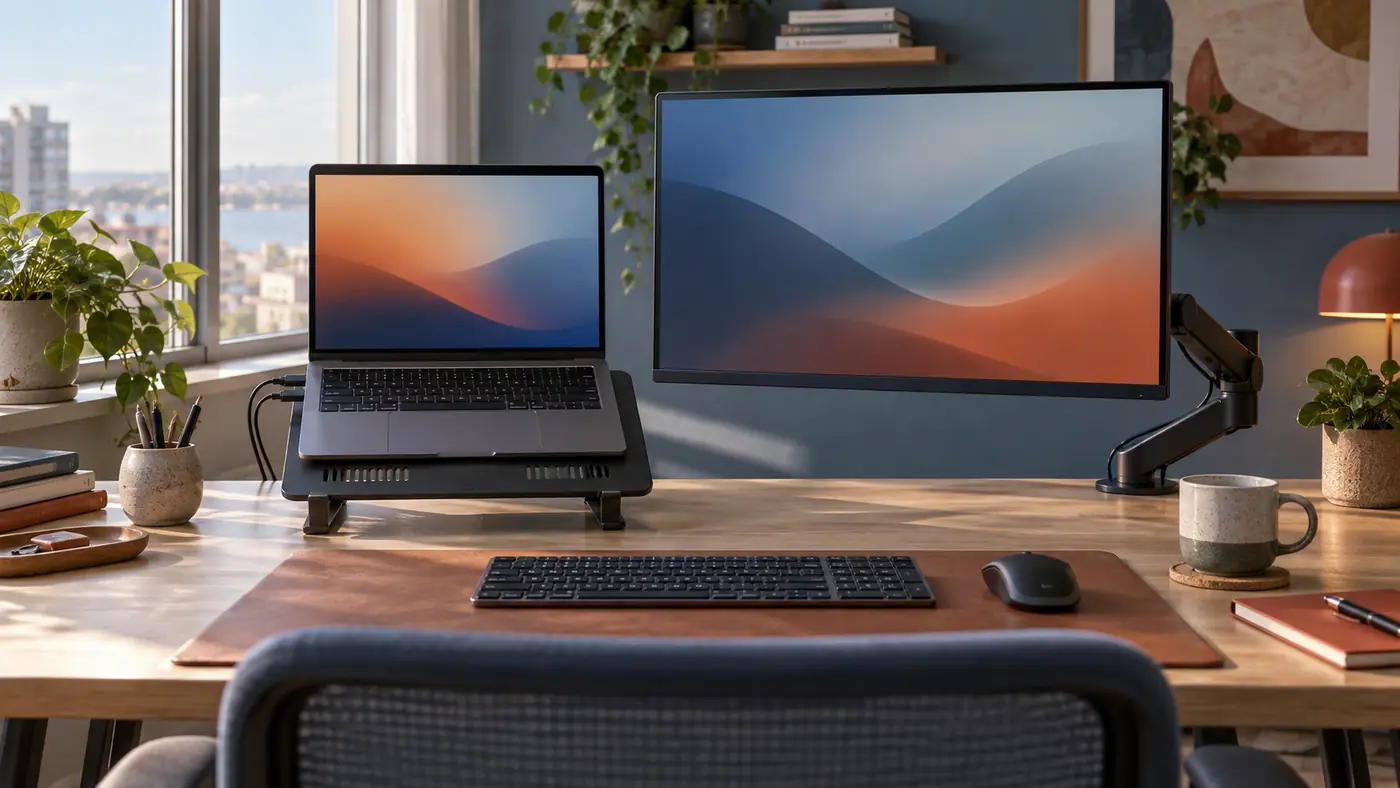
Declare a primary visual surface
Choose which display carries the task that deserves the most neutral head position. Coding, drafting, writing, conferencing, and reference work create different centers. Once the primary surface is named, the secondary laptop can be placed to support it rather than competing for symmetry.
For the specific checkpoint “declare a primary visual surface,” Judge this relationship from the chair with real applications open. Alternate between the primary task, the laptop reference, and a normal conversation posture; notice eye travel and head rotation rather than chasing matching outer frames. Recheck after moving the keyboard or chair, because a screen coordinate has meaning only relative to the seated work center.
The acceptance note for “declare a primary visual surface” should remain separate from every other checkpoint. Record active-area centers, viewing distances, approximate eye line, lid angle, and the task assigned to each display. The geometry is not accepted if legibility requires leaning, the laptop camera is hidden, reflections dominate, or a routine transition demands a large repeated twist. Save useful task states instead of one ornamental arrangement.
Measure from the seated eye position
Sit with the chair, keyboard, and desk at their normal settings. Have someone mark approximate eye height or use a stable reference. Measurements taken while standing at the side often produce a screen height that looks tidy but feels wrong during a long session.
For the specific checkpoint “measure from the seated eye position,” Judge this relationship from the chair with real applications open. Alternate between the primary task, the laptop reference, and a normal conversation posture; notice eye travel and head rotation rather than chasing matching outer frames. Recheck after moving the keyboard or chair, because a screen coordinate has meaning only relative to the seated work center.
The acceptance note for “measure from the seated eye position” should remain separate from every other checkpoint. Record active-area centers, viewing distances, approximate eye line, lid angle, and the task assigned to each display. The geometry is not accepted if legibility requires leaning, the laptop camera is hidden, reflections dominate, or a routine transition demands a large repeated twist. Save useful task states instead of one ornamental arrangement.
Match useful content, not bezel edges
A laptop and desktop monitor differ in physical size, resolution, scaling, and active-area height. Align the parts of the documents you compare frequently. Perfect bezel alignment can be less helpful than placing two working regions on a comfortable visual path.
For the specific checkpoint “match useful content, not bezel edges,” Judge this relationship from the chair with real applications open. Alternate between the primary task, the laptop reference, and a normal conversation posture; notice eye travel and head rotation rather than chasing matching outer frames. Recheck after moving the keyboard or chair, because a screen coordinate has meaning only relative to the seated work center.
The acceptance note for “match useful content, not bezel edges” should remain separate from every other checkpoint. Record active-area centers, viewing distances, approximate eye line, lid angle, and the task assigned to each display. The geometry is not accepted if legibility requires leaning, the laptop camera is hidden, reflections dominate, or a routine transition demands a large repeated twist. Save useful task states instead of one ornamental arrangement.
Set focal distance with real text
Open the applications and text sizes used every day, then position each screen where detail is legible without leaning. A large external display often needs more distance than a laptop. The arm range must support both distances without forcing the keyboard away.
For the specific checkpoint “set focal distance with real text,” Judge this relationship from the chair with real applications open. Alternate between the primary task, the laptop reference, and a normal conversation posture; notice eye travel and head rotation rather than chasing matching outer frames. Recheck after moving the keyboard or chair, because a screen coordinate has meaning only relative to the seated work center.
The acceptance note for “set focal distance with real text” should remain separate from every other checkpoint. Record active-area centers, viewing distances, approximate eye line, lid angle, and the task assigned to each display. The geometry is not accepted if legibility requires leaning, the laptop camera is hidden, reflections dominate, or a routine transition demands a large repeated twist. Save useful task states instead of one ornamental arrangement.
Limit repeated neck rotation
A secondary screen used constantly should not live at an extreme angle. Bring it closer to the primary display and angle both surfaces toward the seated position. A laptop used only for status or calls can tolerate a more distinct side location.
For the specific checkpoint “limit repeated neck rotation,” Judge this relationship from the chair with real applications open. Alternate between the primary task, the laptop reference, and a normal conversation posture; notice eye travel and head rotation rather than chasing matching outer frames. Recheck after moving the keyboard or chair, because a screen coordinate has meaning only relative to the seated work center.
The acceptance note for “limit repeated neck rotation” should remain separate from every other checkpoint. Record active-area centers, viewing distances, approximate eye line, lid angle, and the task assigned to each display. The geometry is not accepted if legibility requires leaning, the laptop camera is hidden, reflections dominate, or a routine transition demands a large repeated twist. Save useful task states instead of one ornamental arrangement.
Reserve camera and lid travel
If the laptop camera matters, place the lens where eye contact is plausible and where the external monitor does not hide it. Open and close the lid through the needed range before locking geometry. A tray position can look correct with the lid fixed yet obstruct travel.
For the specific checkpoint “reserve camera and lid travel,” Judge this relationship from the chair with real applications open. Alternate between the primary task, the laptop reference, and a normal conversation posture; notice eye travel and head rotation rather than chasing matching outer frames. Recheck after moving the keyboard or chair, because a screen coordinate has meaning only relative to the seated work center.
The acceptance note for “reserve camera and lid travel” should remain separate from every other checkpoint. Record active-area centers, viewing distances, approximate eye line, lid angle, and the task assigned to each display. The geometry is not accepted if legibility requires leaning, the laptop camera is hidden, reflections dominate, or a routine transition demands a large repeated twist. Save useful task states instead of one ornamental arrangement.
Check reflections at working angles
Tilt and rotation change what a panel reflects. Evaluate windows, lamps, glossy walls, and bright clothing from the seated point, not from the installer’s standing view. Small angular changes can improve glare without changing the entire layout.
For the specific checkpoint “check reflections at working angles,” Judge this relationship from the chair with real applications open. Alternate between the primary task, the laptop reference, and a normal conversation posture; notice eye travel and head rotation rather than chasing matching outer frames. Recheck after moving the keyboard or chair, because a screen coordinate has meaning only relative to the seated work center.
The acceptance note for “check reflections at working angles” should remain separate from every other checkpoint. Record active-area centers, viewing distances, approximate eye line, lid angle, and the task assigned to each display. The geometry is not accepted if legibility requires leaning, the laptop camera is hidden, reflections dominate, or a routine transition demands a large repeated twist. Save useful task states instead of one ornamental arrangement.
Test transitions between tasks
Move from typing to a call, from the main display to laptop reference, and from screen work to paper. The useful arrangement supports these transitions with modest movement. If every task requires a major arm sweep, the layout may have too many theoretical positions and too few practical ones.
For the specific checkpoint “test transitions between tasks,” Judge this relationship from the chair with real applications open. Alternate between the primary task, the laptop reference, and a normal conversation posture; notice eye travel and head rotation rather than chasing matching outer frames. Recheck after moving the keyboard or chair, because a screen coordinate has meaning only relative to the seated work center.
The acceptance note for “test transitions between tasks” should remain separate from every other checkpoint. Record active-area centers, viewing distances, approximate eye line, lid angle, and the task assigned to each display. The geometry is not accepted if legibility requires leaning, the laptop camera is hidden, reflections dominate, or a routine transition demands a large repeated twist. Save useful task states instead of one ornamental arrangement.
Create two or three named positions
Define a focused-work position, a meeting position, and perhaps a cleared-desk position. Mark or photograph them. Named states make an adjustable setup easier to share and reveal whether the mechanism can reach the positions without cable tension.
For the specific checkpoint “create two or three named positions,” Judge this relationship from the chair with real applications open. Alternate between the primary task, the laptop reference, and a normal conversation posture; notice eye travel and head rotation rather than chasing matching outer frames. Recheck after moving the keyboard or chair, because a screen coordinate has meaning only relative to the seated work center.
The acceptance note for “create two or three named positions” should remain separate from every other checkpoint. Record active-area centers, viewing distances, approximate eye line, lid angle, and the task assigned to each display. The geometry is not accepted if legibility requires leaning, the laptop camera is hidden, reflections dominate, or a routine transition demands a large repeated twist. Save useful task states instead of one ornamental arrangement.
Revisit geometry after adaptation
A new screen arrangement may feel unfamiliar on day one. Distinguish novelty from strain by observing posture and task flow over several sessions. Keep measurements and change one dimension at a time so a later improvement can be attributed to a real adjustment.
For the specific checkpoint “revisit geometry after adaptation,” Judge this relationship from the chair with real applications open. Alternate between the primary task, the laptop reference, and a normal conversation posture; notice eye travel and head rotation rather than chasing matching outer frames. Recheck after moving the keyboard or chair, because a screen coordinate has meaning only relative to the seated work center.
The acceptance note for “revisit geometry after adaptation” should remain separate from every other checkpoint. Record active-area centers, viewing distances, approximate eye line, lid angle, and the task assigned to each display. The geometry is not accepted if legibility requires leaning, the laptop camera is hidden, reflections dominate, or a routine transition demands a large repeated twist. Save useful task states instead of one ornamental arrangement.
Close the guide with an acceptance record
Geometry succeeds when important content sits on a comfortable visual path and ordinary task changes do not demand repeated strain. Keep the record close to this guide’s subject and compare it with the current equipment whenever the workstation changes.
Preserve a few useful measurements rather than a perfect photograph. The workstation should return to helpful positions after movement, cleaning, or another user. Date the conclusion and identify any unresolved point plainly; an acceptance record is a working boundary, never a product certification.