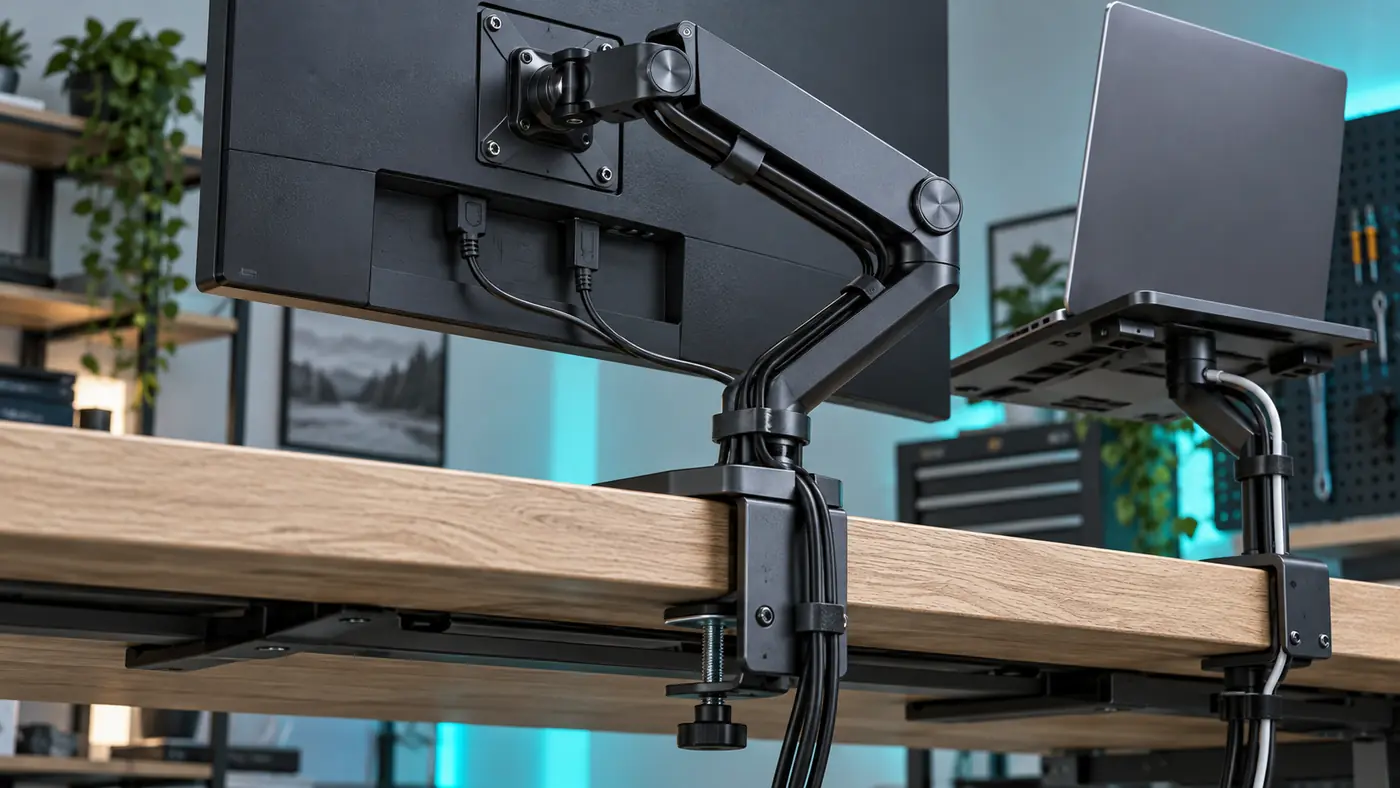
Identify what the desktop is made from
Look beneath the finish for solid wood, plywood, particleboard, a hollow core, laminated layers, honeycomb construction, or a steel subframe. Edge thickness alone is not proof of a strong clamping zone. Inspect manufacturer documentation and furniture labels when the internal structure cannot be seen.
For the specific checkpoint “identify what the desktop is made from,” Inspect this part of the support chain at the underside as well as the finished top. Use a straightedge and light hand pressure to reveal gaps, rocking, local softness, or an obstruction that a catalog photograph cannot show. Repeat the observation with the arm folded and extended because leverage changes at the same clamp without changing the device mass.
The acceptance note for “identify what the desktop is made from” should remain separate from every other checkpoint. Log desk material, edge profile, pad footprint, lower-plate clearance, and distance from the nearest structural feature. A load-path note is useful only when it names where force enters the furniture and what would make that zone unacceptable. Stop for crushed fibers, delamination, rotation, a widening gap, or any contact that is not broad and flat.
Map the underside obstruction zone
Measure from the rear edge to aprons, drawers, rails, cable trays, control boxes, and sit-stand crossmembers. Include room for the lower clamp plate and the tool or handle needed to tighten it. A clamp that barely enters the gap may not seat squarely.
For the specific checkpoint “map the underside obstruction zone,” Inspect this part of the support chain at the underside as well as the finished top. Use a straightedge and light hand pressure to reveal gaps, rocking, local softness, or an obstruction that a catalog photograph cannot show. Repeat the observation with the arm folded and extended because leverage changes at the same clamp without changing the device mass.
The acceptance note for “map the underside obstruction zone” should remain separate from every other checkpoint. Log desk material, edge profile, pad footprint, lower-plate clearance, and distance from the nearest structural feature. A load-path note is useful only when it names where force enters the furniture and what would make that zone unacceptable. Stop for crushed fibers, delamination, rotation, a widening gap, or any contact that is not broad and flat.
Read full-pad contact
Both clamp faces should bear evenly on surfaces intended to carry the load. Rounded edges, large bevels, routed channels, and raised trim can leave a pad touching only a narrow strip. That concentrated contact can mark the desk and make the mount easier to rotate.
For the specific checkpoint “read full-pad contact,” Inspect this part of the support chain at the underside as well as the finished top. Use a straightedge and light hand pressure to reveal gaps, rocking, local softness, or an obstruction that a catalog photograph cannot show. Repeat the observation with the arm folded and extended because leverage changes at the same clamp without changing the device mass.
The acceptance note for “read full-pad contact” should remain separate from every other checkpoint. Log desk material, edge profile, pad footprint, lower-plate clearance, and distance from the nearest structural feature. A load-path note is useful only when it names where force enters the furniture and what would make that zone unacceptable. Stop for crushed fibers, delamination, rotation, a widening gap, or any contact that is not broad and flat.
Understand leverage from reach
A screen close to the pole creates a different moment than the same screen extended toward the user. Add the laptop tray, lid angle, and normal repositioning forces to the picture. Weight capacity is necessary information, but it does not describe every stress at the desktop edge.
For the specific checkpoint “understand leverage from reach,” Inspect this part of the support chain at the underside as well as the finished top. Use a straightedge and light hand pressure to reveal gaps, rocking, local softness, or an obstruction that a catalog photograph cannot show. Repeat the observation with the arm folded and extended because leverage changes at the same clamp without changing the device mass.
The acceptance note for “understand leverage from reach” should remain separate from every other checkpoint. Log desk material, edge profile, pad footprint, lower-plate clearance, and distance from the nearest structural feature. A load-path note is useful only when it names where force enters the furniture and what would make that zone unacceptable. Stop for crushed fibers, delamination, rotation, a widening gap, or any contact that is not broad and flat.
Evaluate reinforcement without improvising
A properly sized reinforcement plate can spread contact when the desk and mount instructions permit it. A random coaster, tiny block, or soft pad may tilt the clamp or creep. Use materials, dimensions, and placement that maintain flat support and do not hide damage.
For the specific checkpoint “evaluate reinforcement without improvising,” Inspect this part of the support chain at the underside as well as the finished top. Use a straightedge and light hand pressure to reveal gaps, rocking, local softness, or an obstruction that a catalog photograph cannot show. Repeat the observation with the arm folded and extended because leverage changes at the same clamp without changing the device mass.
The acceptance note for “evaluate reinforcement without improvising” should remain separate from every other checkpoint. Log desk material, edge profile, pad footprint, lower-plate clearance, and distance from the nearest structural feature. A load-path note is useful only when it names where force enters the furniture and what would make that zone unacceptable. Stop for crushed fibers, delamination, rotation, a widening gap, or any contact that is not broad and flat.
Treat grommet mounting as a separate design
A grommet mount needs a suitable hole, adequate surrounding material, correct hardware, and clear access below. It is not automatically stronger than an edge clamp. Check the furniture maker’s limitations before drilling or repurposing a cable opening.
For the specific checkpoint “treat grommet mounting as a separate design,” Inspect this part of the support chain at the underside as well as the finished top. Use a straightedge and light hand pressure to reveal gaps, rocking, local softness, or an obstruction that a catalog photograph cannot show. Repeat the observation with the arm folded and extended because leverage changes at the same clamp without changing the device mass.
The acceptance note for “treat grommet mounting as a separate design” should remain separate from every other checkpoint. Log desk material, edge profile, pad footprint, lower-plate clearance, and distance from the nearest structural feature. A load-path note is useful only when it names where force enters the furniture and what would make that zone unacceptable. Stop for crushed fibers, delamination, rotation, a widening gap, or any contact that is not broad and flat.
Account for powered desk movement
On a sit-stand desk, the mount rises with the top while wall shelves, power cords, and nearby furniture do not. Test the route from minimum to maximum height. A stable clamp can still participate in an unsafe collision if the environment is ignored.
For the specific checkpoint “account for powered desk movement,” Inspect this part of the support chain at the underside as well as the finished top. Use a straightedge and light hand pressure to reveal gaps, rocking, local softness, or an obstruction that a catalog photograph cannot show. Repeat the observation with the arm folded and extended because leverage changes at the same clamp without changing the device mass.
The acceptance note for “account for powered desk movement” should remain separate from every other checkpoint. Log desk material, edge profile, pad footprint, lower-plate clearance, and distance from the nearest structural feature. A load-path note is useful only when it names where force enters the furniture and what would make that zone unacceptable. Stop for crushed fibers, delamination, rotation, a widening gap, or any contact that is not broad and flat.
Watch for surface compression
Soft fiberboard, damaged laminate, and compliant pads may settle after installation. A previously tight clamp can then move. Inspect the contact outline and alignment after initial use rather than repeatedly overtightening hardware into a surface that is failing.
For the specific checkpoint “watch for surface compression,” Inspect this part of the support chain at the underside as well as the finished top. Use a straightedge and light hand pressure to reveal gaps, rocking, local softness, or an obstruction that a catalog photograph cannot show. Repeat the observation with the arm folded and extended because leverage changes at the same clamp without changing the device mass.
The acceptance note for “watch for surface compression” should remain separate from every other checkpoint. Log desk material, edge profile, pad footprint, lower-plate clearance, and distance from the nearest structural feature. A load-path note is useful only when it names where force enters the furniture and what would make that zone unacceptable. Stop for crushed fibers, delamination, rotation, a widening gap, or any contact that is not broad and flat.
Record the accepted clamp zone
Measure the final mount location from a durable desk reference and photograph the underside contact. Note any reinforcement and obstruction clearance. This small record helps after cleaning, relocation, or a future screen change.
For the specific checkpoint “record the accepted clamp zone,” Inspect this part of the support chain at the underside as well as the finished top. Use a straightedge and light hand pressure to reveal gaps, rocking, local softness, or an obstruction that a catalog photograph cannot show. Repeat the observation with the arm folded and extended because leverage changes at the same clamp without changing the device mass.
The acceptance note for “record the accepted clamp zone” should remain separate from every other checkpoint. Log desk material, edge profile, pad footprint, lower-plate clearance, and distance from the nearest structural feature. A load-path note is useful only when it names where force enters the furniture and what would make that zone unacceptable. Stop for crushed fibers, delamination, rotation, a widening gap, or any contact that is not broad and flat.
Know when to stop
Cracking, crushed cores, delamination, significant flex, missing structural information, or a clamp that cannot sit flat are reasons to pause. Seek authoritative guidance or select a different support method instead of turning uncertainty into more tightening force.
For the specific checkpoint “know when to stop,” Inspect this part of the support chain at the underside as well as the finished top. Use a straightedge and light hand pressure to reveal gaps, rocking, local softness, or an obstruction that a catalog photograph cannot show. Repeat the observation with the arm folded and extended because leverage changes at the same clamp without changing the device mass.
The acceptance note for “know when to stop” should remain separate from every other checkpoint. Log desk material, edge profile, pad footprint, lower-plate clearance, and distance from the nearest structural feature. A load-path note is useful only when it names where force enters the furniture and what would make that zone unacceptable. Stop for crushed fibers, delamination, rotation, a widening gap, or any contact that is not broad and flat.
Close the guide with an acceptance record
The governing question is whether the path from device to arm, arm to clamp, and clamp to desk can be described without guesswork. Keep the record close to this guide’s subject and compare it with the current equipment whenever the workstation changes.
Keep measurements, approved constraints, and stop conditions together. A clean-looking edge is not enough; stable support depends on the material and contact hidden beneath it. Date the conclusion and identify any unresolved point plainly; an acceptance record is a working boundary, never a product certification.