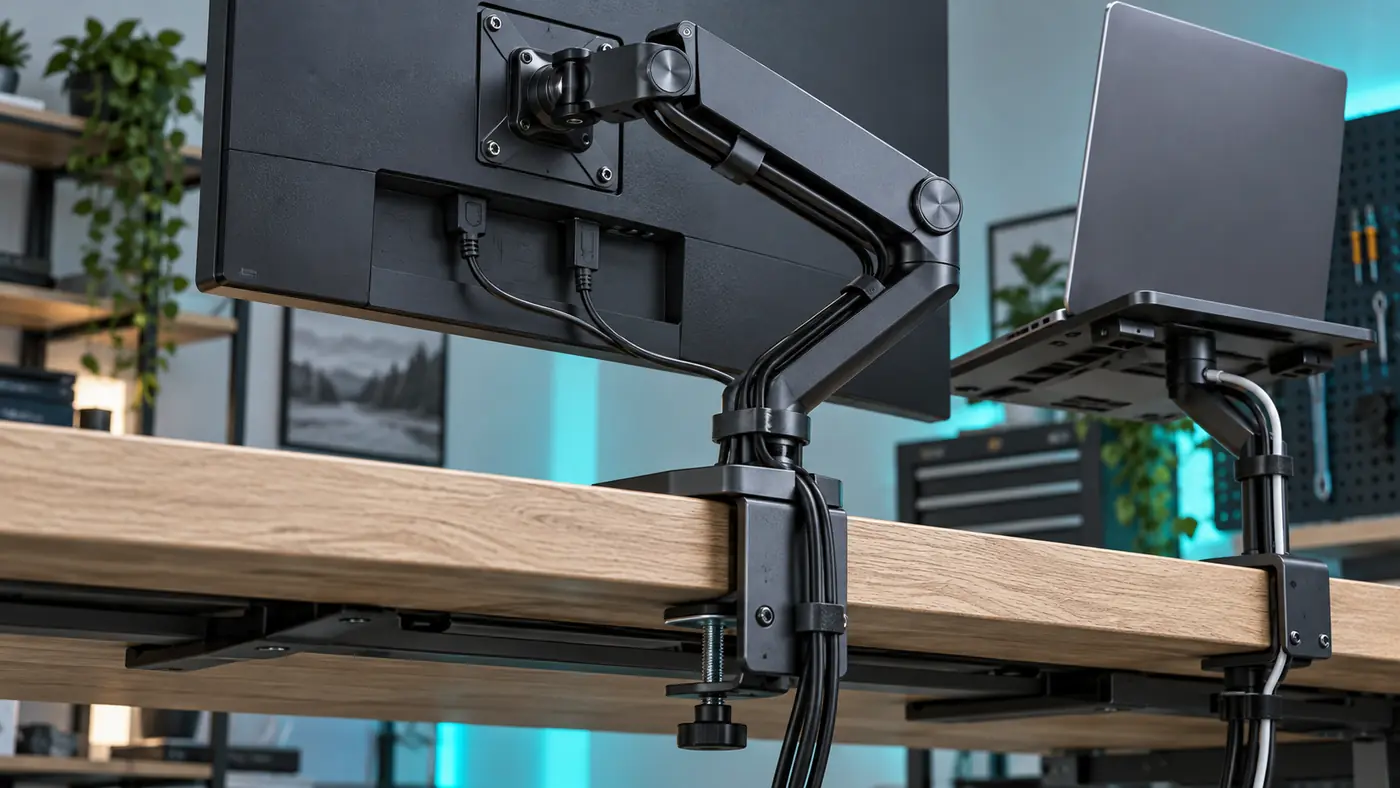
Inventory every moving connection
List monitor power, video, laptop power, dock, network, audio, camera, and peripheral leads. Mark which endpoints move with the arm and which remain fixed. This separates cables that need a travel loop from those that should stay anchored to the desk.
For the specific checkpoint “inventory every moving connection,” Follow this lead with one hand near the moving connector while the other moves a single pivot slowly. Observe when a service loop opens, closes, twists, or brushes a hinge, and repeat at maximum desk height where applicable. Cable behavior must be witnessed through travel; a tidy still image says nothing about hidden pull at the far reach.
The acceptance note for “inventory every moving connection” should remain separate from every other checkpoint. Map fixed endpoint, moving endpoint, nearest anchor, broadest bend, and the amount of recoverable slack. Note where a cover or tie changes friction. Revise the route for connector leverage, jacket polishing, a loop entering a joint, a hanging adapter, or any wire that returns the arm toward one position after release.
Find the farthest connector distance
Place both screens at the most distant planned positions and route cables gently to their endpoints. Add only the service slack needed for bends and maintenance. Measuring in the parked position alone often produces a cable that tugs when the arm extends.
For the specific checkpoint “find the farthest connector distance,” Follow this lead with one hand near the moving connector while the other moves a single pivot slowly. Observe when a service loop opens, closes, twists, or brushes a hinge, and repeat at maximum desk height where applicable. Cable behavior must be witnessed through travel; a tidy still image says nothing about hidden pull at the far reach.
The acceptance note for “find the farthest connector distance” should remain separate from every other checkpoint. Map fixed endpoint, moving endpoint, nearest anchor, broadest bend, and the amount of recoverable slack. Note where a cover or tie changes friction. Revise the route for connector leverage, jacket polishing, a loop entering a joint, a hanging adapter, or any wire that returns the arm toward one position after release.
Cycle each pivot slowly
Watch the cable at the base, elbow, tilt head, tray, and device port while moving one joint at a time. A lead may look loose overall yet tighten around a single pivot. Slow motion reveals twisting and pinch points before repeated use damages a jacket or connector.
For the specific checkpoint “cycle each pivot slowly,” Follow this lead with one hand near the moving connector while the other moves a single pivot slowly. Observe when a service loop opens, closes, twists, or brushes a hinge, and repeat at maximum desk height where applicable. Cable behavior must be witnessed through travel; a tidy still image says nothing about hidden pull at the far reach.
The acceptance note for “cycle each pivot slowly” should remain separate from every other checkpoint. Map fixed endpoint, moving endpoint, nearest anchor, broadest bend, and the amount of recoverable slack. Note where a cover or tie changes friction. Revise the route for connector leverage, jacket polishing, a loop entering a joint, a hanging adapter, or any wire that returns the arm toward one position after release.
Respect bend radius and connector direction
Keep curves broad enough for the cable type and align plugs so they are not levered sideways. Thick display and power leads may resist a compact arm channel. Do not force them under a cover designed for a smaller bundle.
For the specific checkpoint “respect bend radius and connector direction,” Follow this lead with one hand near the moving connector while the other moves a single pivot slowly. Observe when a service loop opens, closes, twists, or brushes a hinge, and repeat at maximum desk height where applicable. Cable behavior must be witnessed through travel; a tidy still image says nothing about hidden pull at the far reach.
The acceptance note for “respect bend radius and connector direction” should remain separate from every other checkpoint. Map fixed endpoint, moving endpoint, nearest anchor, broadest bend, and the amount of recoverable slack. Note where a cover or tie changes friction. Revise the route for connector leverage, jacket polishing, a loop entering a joint, a hanging adapter, or any wire that returns the arm toward one position after release.
Anchor before fragile ports
Provide strain relief on the arm or tray near the laptop, leaving a small relaxed segment to the connector. The anchor should carry ordinary cable movement, not the port. Avoid adhesive or tie placement over vents and removable access panels.
For the specific checkpoint “anchor before fragile ports,” Follow this lead with one hand near the moving connector while the other moves a single pivot slowly. Observe when a service loop opens, closes, twists, or brushes a hinge, and repeat at maximum desk height where applicable. Cable behavior must be witnessed through travel; a tidy still image says nothing about hidden pull at the far reach.
The acceptance note for “anchor before fragile ports” should remain separate from every other checkpoint. Map fixed endpoint, moving endpoint, nearest anchor, broadest bend, and the amount of recoverable slack. Note where a cover or tie changes friction. Revise the route for connector leverage, jacket polishing, a loop entering a joint, a hanging adapter, or any wire that returns the arm toward one position after release.
Give the dock an independent home
A dock with several stiff leads can become a hanging weight if left suspended from the computer. Support it on the desk, under a suitable mount, or on a stable shelf, then use a flexible replaceable connection across the moving boundary.
For the specific checkpoint “give the dock an independent home,” Follow this lead with one hand near the moving connector while the other moves a single pivot slowly. Observe when a service loop opens, closes, twists, or brushes a hinge, and repeat at maximum desk height where applicable. Cable behavior must be witnessed through travel; a tidy still image says nothing about hidden pull at the far reach.
The acceptance note for “give the dock an independent home” should remain separate from every other checkpoint. Map fixed endpoint, moving endpoint, nearest anchor, broadest bend, and the amount of recoverable slack. Note where a cover or tie changes friction. Revise the route for connector leverage, jacket polishing, a loop entering a joint, a hanging adapter, or any wire that returns the arm toward one position after release.
Separate power from frequent swaps
Long-lived monitor wiring can use integrated arm guides, while the laptop charge or dock lead should remain accessible. This division prevents every device change from disturbing the whole loom and makes port inspection possible.
For the specific checkpoint “separate power from frequent swaps,” Follow this lead with one hand near the moving connector while the other moves a single pivot slowly. Observe when a service loop opens, closes, twists, or brushes a hinge, and repeat at maximum desk height where applicable. Cable behavior must be witnessed through travel; a tidy still image says nothing about hidden pull at the far reach.
The acceptance note for “separate power from frequent swaps” should remain separate from every other checkpoint. Map fixed endpoint, moving endpoint, nearest anchor, broadest bend, and the amount of recoverable slack. Note where a cover or tie changes friction. Revise the route for connector leverage, jacket polishing, a loop entering a joint, a hanging adapter, or any wire that returns the arm toward one position after release.
Include sit-stand travel
Route desk power and network leads with enough vertical travel between the moving top and fixed wall or floor. Check the highest and lowest settings while watching obstacles. Do not rely on a connector to stop the desk before a cable is pulled tight.
For the specific checkpoint “include sit-stand travel,” Follow this lead with one hand near the moving connector while the other moves a single pivot slowly. Observe when a service loop opens, closes, twists, or brushes a hinge, and repeat at maximum desk height where applicable. Cable behavior must be witnessed through travel; a tidy still image says nothing about hidden pull at the far reach.
The acceptance note for “include sit-stand travel” should remain separate from every other checkpoint. Map fixed endpoint, moving endpoint, nearest anchor, broadest bend, and the amount of recoverable slack. Note where a cover or tie changes friction. Revise the route for connector leverage, jacket polishing, a loop entering a joint, a hanging adapter, or any wire that returns the arm toward one position after release.
Label endpoints, not the visible middle
Small identifiers near the dock, display, and power source help future changes without filling the desktop with labels. Keep text out of the public-facing visual system, but use clear local identification where multiple similar leads create maintenance errors.
For the specific checkpoint “label endpoints, not the visible middle,” Follow this lead with one hand near the moving connector while the other moves a single pivot slowly. Observe when a service loop opens, closes, twists, or brushes a hinge, and repeat at maximum desk height where applicable. Cable behavior must be witnessed through travel; a tidy still image says nothing about hidden pull at the far reach.
The acceptance note for “label endpoints, not the visible middle” should remain separate from every other checkpoint. Map fixed endpoint, moving endpoint, nearest anchor, broadest bend, and the amount of recoverable slack. Note where a cover or tie changes friction. Revise the route for connector leverage, jacket polishing, a loop entering a joint, a hanging adapter, or any wire that returns the arm toward one position after release.
Retest after bundling
Cable management changes friction and the center of pull. Run the complete motion check after covers, clips, and ties are closed. If the arm begins to drift or return to one position, release the hidden cable force rather than compensating only with more joint tension.
For the specific checkpoint “retest after bundling,” Follow this lead with one hand near the moving connector while the other moves a single pivot slowly. Observe when a service loop opens, closes, twists, or brushes a hinge, and repeat at maximum desk height where applicable. Cable behavior must be witnessed through travel; a tidy still image says nothing about hidden pull at the far reach.
The acceptance note for “retest after bundling” should remain separate from every other checkpoint. Map fixed endpoint, moving endpoint, nearest anchor, broadest bend, and the amount of recoverable slack. Note where a cover or tie changes friction. Revise the route for connector leverage, jacket polishing, a loop entering a joint, a hanging adapter, or any wire that returns the arm toward one position after release.
Close the guide with an acceptance record
A successful route stays relaxed through the complete intended motion while keeping connectors free from load. Keep the record close to this guide’s subject and compare it with the current equipment whenever the workstation changes.
Treat visual tidiness as the result of correct travel planning, not the first objective. If a bundle fights the mechanism, the path needs revision. Date the conclusion and identify any unresolved point plainly; an acceptance record is a working boundary, never a product certification.