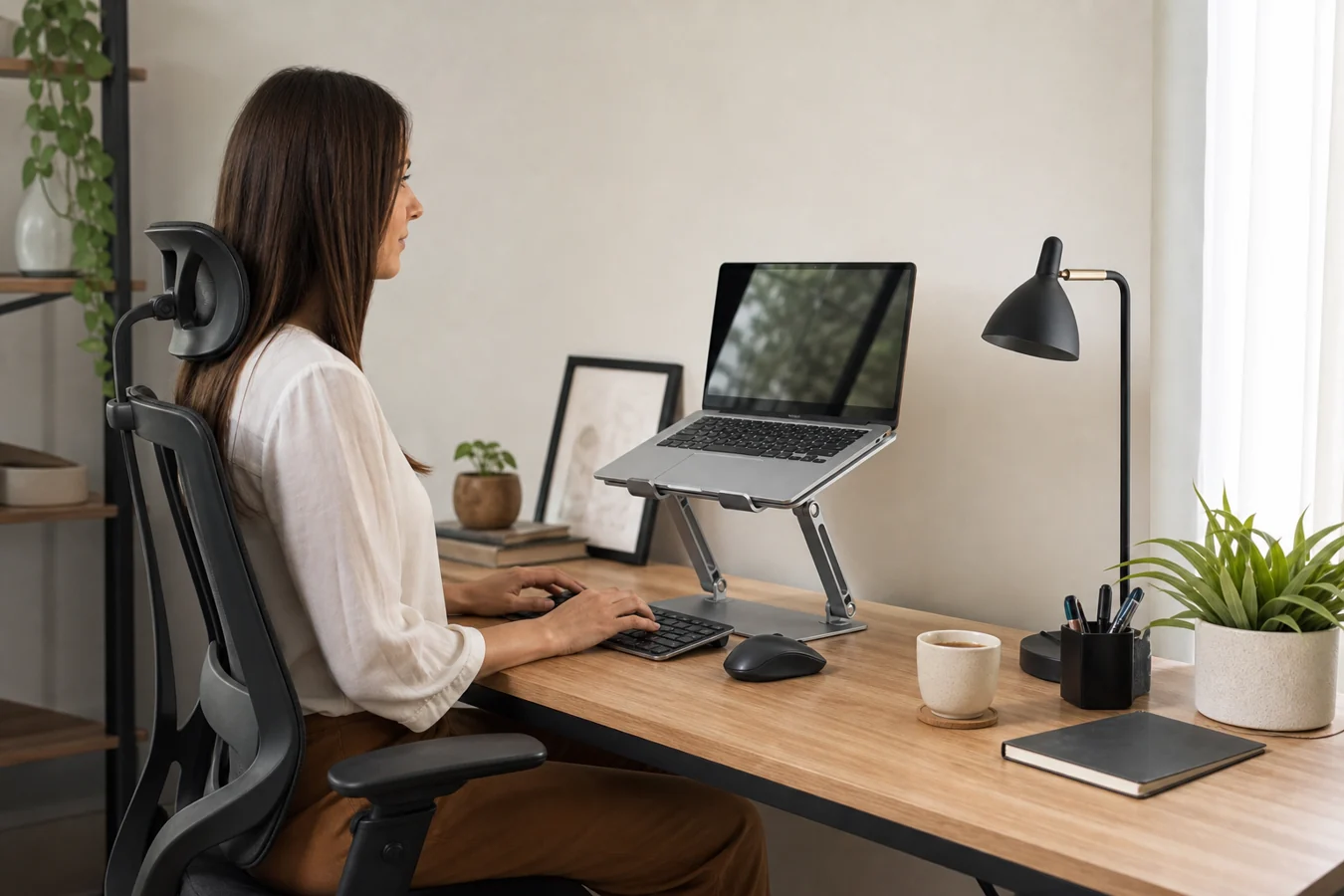
Use this posture-first guide alongside the LeStallion laptop stand recommendations to choose a stand around real desk habits, not just product photos.
Raise the screen without craning upward.
Use an external keyboard for long sessions.
Check wobble with the real laptop.
Measure desk depth before buying.
Leave airflow and port access clear.
Make setup fast enough to repeat daily.
Start with eye line, not stand height
A laptop stand is only useful when it raises the screen toward a calmer viewing position. The goal is not to make the laptop tall for its own sake; it is to reduce the curled-neck habit that appears after long writing, browsing, and video-call sessions.
Set the laptop where it will actually be used, then check whether the top third of the screen sits near eye level. A tall user, a low chair, and a deep desk can all change the right answer.
The practical check is to test the same chair, keyboard, mouse, and laptop angle that will be used after purchase.
Separate typing comfort from screen height
Most laptop stands work best with an external keyboard and mouse. Raising the whole laptop helps the eyes, but it can make the built-in keyboard awkward. Treat the stand, keyboard, and pointer as one ergonomic system.
If the setup needs to travel, choose a stand that still leaves space for a compact keyboard or a comfortable trackpad routine.
The practical check is to test the same chair, keyboard, mouse, and laptop angle that will be used after purchase.
Stability is a posture feature
A wobbly stand makes people lower the laptop, hunch forward, or stop using the stand altogether. Stability matters during typing, screen taps, cable changes, and quick laptop removal.
Check the hinge feel, base width, rubber grip, and how the stand behaves with the actual laptop size. Lightweight is useful, but not if it feels nervous on the desk.
The practical check is to test the same chair, keyboard, mouse, and laptop angle that will be used after purchase.
Small desks need a different plan
A stand can improve posture while also stealing depth from the desk. On compact desks, the keyboard may move too close to the body or the laptop may block notebooks and coffee.
Map the footprint before buying. The best small-desk stand often creates vertical organization without making the work surface feel crowded.
The practical check is to test the same chair, keyboard, mouse, and laptop angle that will be used after purchase.
Cooling and cable access matter
Some laptop stands improve airflow, which can help during video calls, spreadsheets, or creative work. But ports, chargers, hubs, and webcam angles still need room.
A tidy cable route prevents the laptop from being pulled sideways and keeps the stand from looking like a temporary stack of accessories.
The practical check is to test the same chair, keyboard, mouse, and laptop angle that will be used after purchase.
Portable stands trade features for habit
A portable stand is valuable when it is actually carried. The best travel option folds quickly, protects the laptop from scratches, and does not require a complicated desk rebuild.
For daily commuters, a slightly less adjustable stand may beat a premium model if it fits the bag and sets up in seconds.
The practical check is to test the same chair, keyboard, mouse, and laptop angle that will be used after purchase.
Build a repeatable posture routine
Good posture is less about one perfect angle and more about repeatable resets. At the start of a work block, place the laptop, keyboard, mouse, chair, and screen distance before opening every app.
A simple routine prevents the stand from becoming decoration. If the user forgets to use it, the setup is too slow or too far away.
The practical check is to test the same chair, keyboard, mouse, and laptop angle that will be used after purchase.
Video calls change the setup
Laptop stands often improve camera angle by lifting the webcam away from the desk. That can make calls feel more natural, especially when paired with a stable chair and soft lighting.
Still, avoid pushing the screen so high that the user cranes upward. The call angle should support eye contact without sacrificing typing comfort.
The practical check is to test the same chair, keyboard, mouse, and laptop angle that will be used after purchase.
Materials affect daily confidence
Metal stands can feel stable and premium, while lighter plastic or composite stands may be easier to carry. The best material depends on desk permanence, laptop weight, and travel needs.
Look for grip pads, smooth edges, and adjustment joints that do not feel loose after repeated changes.
The practical check is to test the same chair, keyboard, mouse, and laptop angle that will be used after purchase.
The one-week editor test
Use the stand for a normal week, not a staged desk photo. Track whether the neck relaxes, whether the keyboard stays comfortable, whether the laptop feels secure, and whether the setup survives rushed meetings.
If the stand works only when the desk is perfectly clean, it may not match the real routine.
The practical check is to test the same chair, keyboard, mouse, and laptop angle that will be used after purchase.
Use rankings after the setup is defined
Product rankings are most useful after the buyer knows the main problem: eye height, portability, small desk footprint, cooling, or stability. Once the workflow is clear, the LeStallion comparison becomes easier to judge.
That is why this guide frames the decision before sending readers to the product shortlist.
The practical check is to test the same chair, keyboard, mouse, and laptop angle that will be used after purchase.
Keep the stand easy to clean and reset
Dust, fingerprints, crumbs, and cable drag can make even a good stand feel messy. Choose a setup that can be wiped quickly and returned to the same position after cleaning.
A small mark on the desk or a repeated cable route can make the daily reset automatic.
The practical check is to test the same chair, keyboard, mouse, and laptop angle that will be used after purchase.
Related reading
Return to the laptop stand posture shortlist, or follow the previous cloud guide on wireless presentation remotes for seamless slideshows.
Deep-dive support pages
Focused posture notes for height and eye line.Keyboard and Mouse Setup
Focused posture notes for keyboard and mouse setup.Portable Laptop Stands
Focused posture notes for portable laptop stands.Small Desk Space
Focused posture notes for small desk space.Cooling and Stability
Focused posture notes for cooling and stability.Home Office Routine
Focused posture notes for home office routine.