This support page focuses on full-grain vs top-grain leather: what executive buyers should notice for executive leather briefcases. The main shortlist covers product options; this page keeps the buying context clear and practical.
Full-Grain vs Top-Grain Leather: What Executive Buyers Should Notice
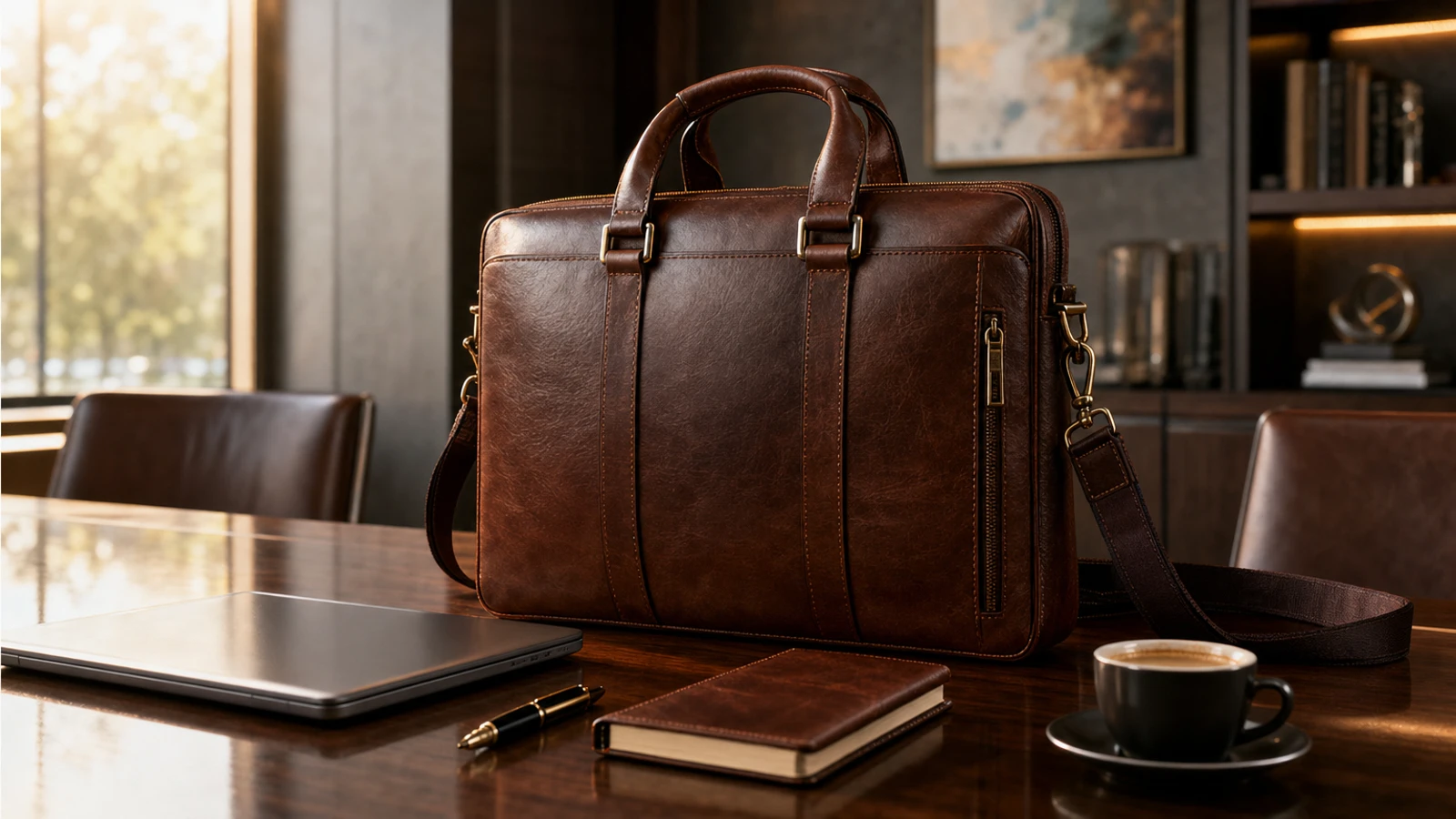
Start with the surface, not the sales phrase. Full-grain leather usually keeps more of the natural hide surface, so small grain variation, pores, and subtle marks can be signs of character rather than defects. Top-grain leather can still be excellent, especially when it is evenly finished and paired with strong construction. For an executive briefcase, the useful question is whether the leather looks better after months of meetings, flights, and elevator rides, or whether it simply looks shiny in the product photo.
Look at corners and stress points. A briefcase ages first at the corners, handle anchors, strap tabs, bottom edges, and flap crease. If those zones look thin, heavily corrected, or loosely stitched, the leather grade matters less than the weak build. A polished executive bag should feel firm enough to stand up, yet supple enough that the flap and handles do not crack when used daily.
Match leather character to the office. A very rugged pull-up leather can look beautiful, but it may feel casual beside conservative tailoring. A smooth cognac, espresso, black, or oxblood finish usually reads more boardroom-friendly. Choose patina if you enjoy visible history; choose a more even finish if your role demands a crisp, quiet appearance every day.
Do a practical care check before buying. Leather that needs constant conditioning, careful weather avoidance, or special storage may not fit a heavy commute. Before choosing, check whether the maker explains care, dye transfer, water spotting, and warranty coverage. A good executive briefcase should invite care, not create anxiety every time rain appears.
Avoid fake certainty. No support article can verify every current product batch from a listing alone. Use product dimensions, seller photos, return terms, and owner feedback together, then compare those details with LeStallion’s active shortlist before deciding which leather grade gives the right balance of polish and endurance.
Practical decision notes
Executive scenario 1: Start with the surface, not the sales phrase. In a real buying conversation, this point deserves a second pass because full-grain leather usually keeps more of the natural hide surface, so small grain variation, pores, and subtle marks can be signs of character rather than defects. top-grain leather can still be excellent, especially when it is evenly finished and paired with strong construction. for an executive briefcase, the useful question is whether the leather looks better after months of meetings, flights, and elevator rides, or whether it simply looks shiny in the product photo. Ask whether that detail still feels right after the briefcase is packed with a laptop, papers, charger, pen, phone, keys, and one personal item. If the answer depends on perfect conditions, keep comparing before treating the case as a long-term professional carry.
Inspection cue 1. For full-grain vs top-grain leather: what executive buyers should notice, look beyond the front product image and study the side profile, open interior, bottom edge, handle area, and closure behavior. A polished executive briefcase should make this specific detail easy to understand without guessing, because the bag will be opened, lifted, placed down, and repacked repeatedly during client-facing work.
Decision filter 1. Keep this question tied to the owner's actual routine: commute length, meeting formality, document sensitivity, device size, wardrobe color, travel frequency, and willingness to care for leather. The right answer is the one that still feels calm and useful after several ordinary workweeks, not only during the excitement of unboxing.
Executive scenario 2: Look at corners and stress points. In a real buying conversation, this point deserves a second pass because a briefcase ages first at the corners, handle anchors, strap tabs, bottom edges, and flap crease. if those zones look thin, heavily corrected, or loosely stitched, the leather grade matters less than the weak build. a polished executive bag should feel firm enough to stand up, yet supple enough that the flap and handles do not crack when used daily. Ask whether that detail still feels right after the briefcase is packed with a laptop, papers, charger, pen, phone, keys, and one personal item. If the answer depends on perfect conditions, keep comparing before treating the case as a long-term professional carry.
Inspection cue 2. For full-grain vs top-grain leather: what executive buyers should notice, look beyond the front product image and study the side profile, open interior, bottom edge, handle area, and closure behavior. A polished executive briefcase should make this specific detail easy to understand without guessing, because the bag will be opened, lifted, placed down, and repacked repeatedly during client-facing work.
Decision filter 2. Keep this question tied to the owner's actual routine: commute length, meeting formality, document sensitivity, device size, wardrobe color, travel frequency, and willingness to care for leather. The right answer is the one that still feels calm and useful after several ordinary workweeks, not only during the excitement of unboxing.
Executive scenario 3: Match leather character to the office. In a real buying conversation, this point deserves a second pass because a very rugged pull-up leather can look beautiful, but it may feel casual beside conservative tailoring. a smooth cognac, espresso, black, or oxblood finish usually reads more boardroom-friendly. choose patina if you enjoy visible history; choose a more even finish if your role demands a crisp, quiet appearance every day. Ask whether that detail still feels right after the briefcase is packed with a laptop, papers, charger, pen, phone, keys, and one personal item. If the answer depends on perfect conditions, keep comparing before treating the case as a long-term professional carry.
Inspection cue 3. For full-grain vs top-grain leather: what executive buyers should notice, look beyond the front product image and study the side profile, open interior, bottom edge, handle area, and closure behavior. A polished executive briefcase should make this specific detail easy to understand without guessing, because the bag will be opened, lifted, placed down, and repacked repeatedly during client-facing work.
Decision filter 3. Keep this question tied to the owner's actual routine: commute length, meeting formality, document sensitivity, device size, wardrobe color, travel frequency, and willingness to care for leather. The right answer is the one that still feels calm and useful after several ordinary workweeks, not only during the excitement of unboxing.
Executive scenario 4: Do a practical care check before buying. In a real buying conversation, this point deserves a second pass because leather that needs constant conditioning, careful weather avoidance, or special storage may not fit a heavy commute. before choosing, check whether the maker explains care, dye transfer, water spotting, and warranty coverage. a good executive briefcase should invite care, not create anxiety every time rain appears. Ask whether that detail still feels right after the briefcase is packed with a laptop, papers, charger, pen, phone, keys, and one personal item. If the answer depends on perfect conditions, keep comparing before treating the case as a long-term professional carry.
Inspection cue 4. For full-grain vs top-grain leather: what executive buyers should notice, look beyond the front product image and study the side profile, open interior, bottom edge, handle area, and closure behavior. A polished executive briefcase should make this specific detail easy to understand without guessing, because the bag will be opened, lifted, placed down, and repacked repeatedly during client-facing work.
Decision filter 4. Keep this question tied to the owner's actual routine: commute length, meeting formality, document sensitivity, device size, wardrobe color, travel frequency, and willingness to care for leather. The right answer is the one that still feels calm and useful after several ordinary workweeks, not only during the excitement of unboxing.
Executive scenario 5: Avoid fake certainty. In a real buying conversation, this point deserves a second pass because no support article can verify every current product batch from a listing alone. use product dimensions, seller photos, return terms, and owner feedback together, then compare those details with lestallion’s active shortlist before deciding which leather grade gives the right balance of polish and endurance. Ask whether that detail still feels right after the briefcase is packed with a laptop, papers, charger, pen, phone, keys, and one personal item. If the answer depends on perfect conditions, keep comparing before treating the case as a long-term professional carry.
Inspection cue 5. For full-grain vs top-grain leather: what executive buyers should notice, look beyond the front product image and study the side profile, open interior, bottom edge, handle area, and closure behavior. A polished executive briefcase should make this specific detail easy to understand without guessing, because the bag will be opened, lifted, placed down, and repacked repeatedly during client-facing work.
Decision filter 5. Keep this question tied to the owner's actual routine: commute length, meeting formality, document sensitivity, device size, wardrobe color, travel frequency, and willingness to care for leather. The right answer is the one that still feels calm and useful after several ordinary workweeks, not only during the excitement of unboxing.
Use the hub and related support pages to compare leather briefcase details before choosing a professional work bag.